QSAR Toxicity Prediction (GWO-ANN)
Undergraduate thesis, accepted at IC2IE 2026. A neural network tuned by the Grey Wolf Optimizer predicts whether a chemical is toxic to the estrogen receptor, on data with 18.6 non-toxic samples for every toxic one.
- Python
- TensorFlow / Keras
- Scikit-learn
- RDKit
- imbalanced-learn
- NiaPy
- Pandas
- NumPy
OVERVIEW
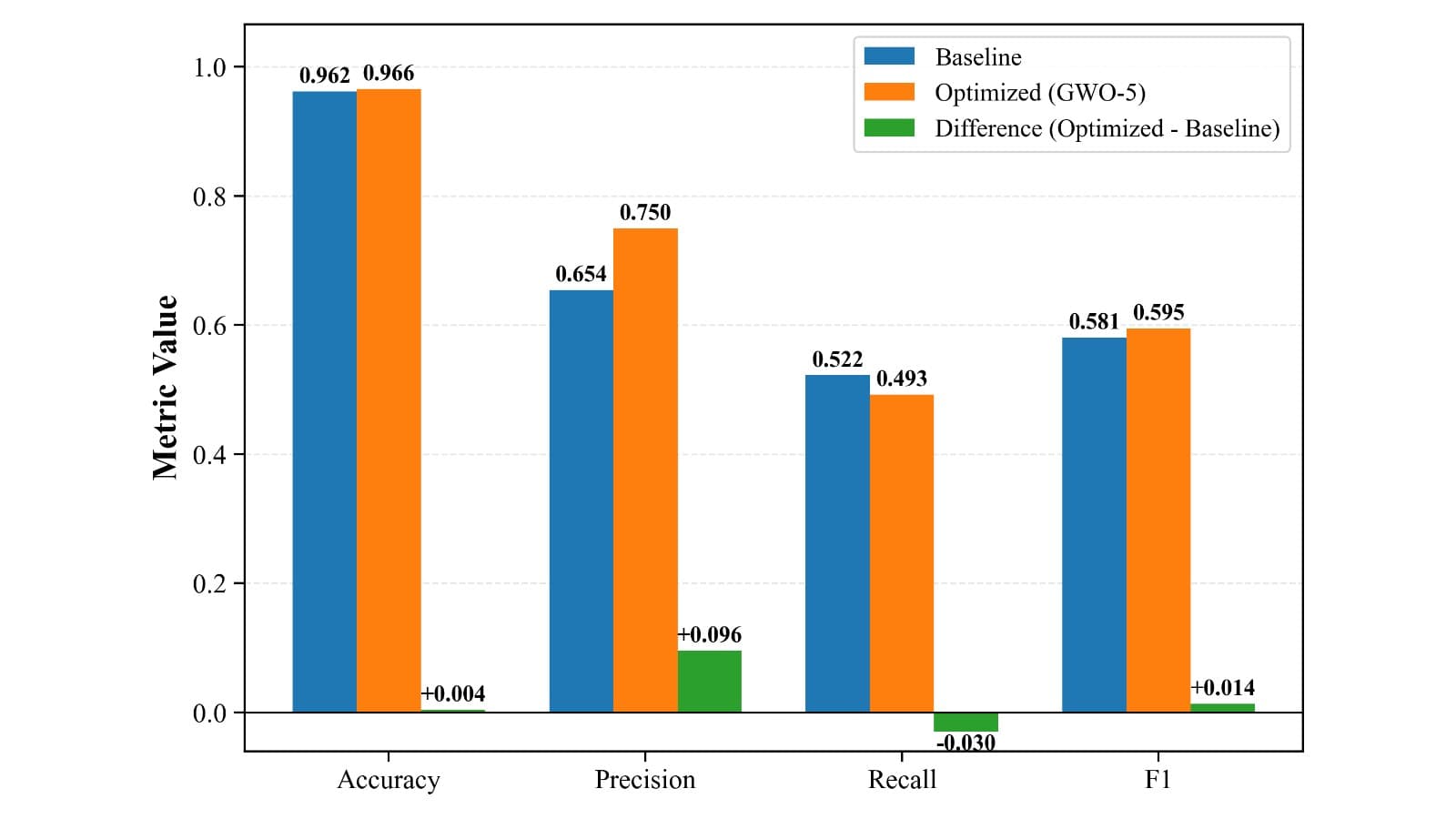
The thesis predicts chemical toxicity against the estrogen receptor (Tox21, NR-ER-LBD), where toxic compounds are rare. Each molecule was turned into Morgan fingerprints and RDKit descriptors, reduced to 500 features with mutual information, and balanced with SMOTETomek. Three hand-tuned networks were compared with networks whose hyperparameters were chosen by the Grey Wolf Optimizer, across 5 random seeds. The best optimized model reached an F1-score of 0.5946 against 0.5778 for the best hand-tuned one, with a smaller gap between training and test results.
WHAT I DID
- Chemical feature extraction from SMILES via Morgan Fingerprint (ECFP4) and RDKit molecular descriptors, reduced to 500 features by Mutual Information Selection.
- Class imbalance handled with SMOTETomek (combined over- and under-sampling) on an 18.6:1 imbalanced Tox21 endpoint.
- Three manually tuned ANN baselines compared against models auto-tuned by the Grey Wolf Optimizer across 5 random seeds for stability.
- Best GWO model (seed 3103) reached F1-Score 0.5946 versus 0.5778 for the best manual baseline, with a smaller generalization gap.